
Rare earth elements (REEs) – the 17 lanthanides plus yttrium – are ubiquitous in modern technology due to their unique magnetic, catalytic, and optical properties. They power high-performance permanent magnets (neodymium, praseodymium, dysprosium, terbium) used in electric vehicle (EV) motors, wind turbine generators, laptops and fighter jets. Other REEs serve as catalysts and battery materials: for example, cerium and lanthanum are integral to catalytic converters and nickel-metal hydride batteries (requiring 10–15 kg per hybrid car). Yttrium and related heavy REEs are used in advanced defense systems (lasers, radar, superconductors) and LEDs. In short, rare earths are “vital to modern technologies and lifestyles,” from consumer electronics (smartphones, cameras, screens) to clean energy and defense applications.
- Magnets for EVs and turbines: Neodymium-praseodymium (NdPr) and dysprosium-terbium heavy-REE magnets deliver unmatched strength per weight, enabling compact EV motors and direct-drive wind generators.
- Electronics and optics: Lanthanum, cerium and gadolinium are used in camera lenses, optical glass and disk drives.
- Defense hardware: Yttrium, samarium and others are found in jet engines, missile guidance systems and night-vision equipment.
China’s Stranglehold on Mining and Processing
China dominates every stage of the rare-earth supply chain. It produces a lion’s share of the raw ore and almost all the processed metals and magnets. China’s Bayan Obo deposit (Inner Mongolia) alone is the world’s largest REE mine, with over 100 million tonnes of resources (some 80% of China’s known REE reserves). That single complex accounts for roughly 40% of the world’s REE reserves and nearly half of global rare-earth output. Additional Chinese sources include southern ion-adsorption clays (notably in Jiangxi Province) and numerous smaller deposits. China also imports significant ore from Myanmar (Burma), where Chinese companies and middlemen operate large, often informal, ion-adsorption clay mines. (Myanmar in 2023 supplied ~10.9% of global REE production, with much of it flowing into China for processing.)
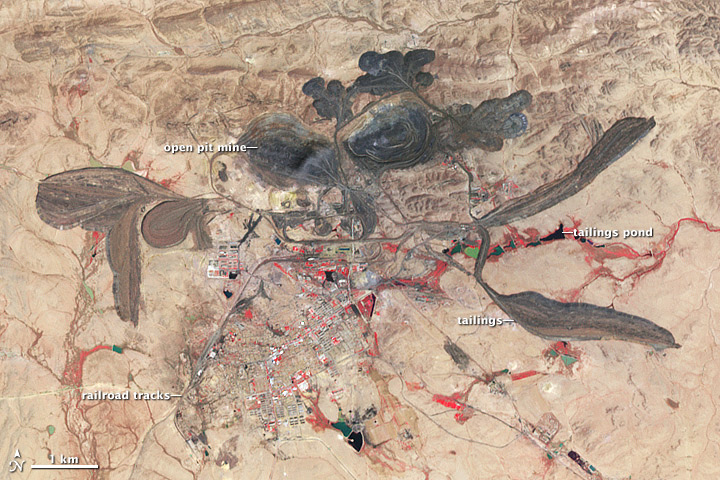
China’s mining output dwarfs that of any other country. In 2023, world rare-earth mine production was about 350,000 tonnes (REO). The U.S. Geological Survey (USGS) reports that China produced on the order of 110–120 thousand tonnes that year (quasi-official quotas, 112,000 in 2022; 124,000 in 2023) – roughly one-third of global output by that measure. (Industry analysts note China’s actual share may be even higher, estimating it at ~60–69% of production in 2023.) By comparison, the only other significant producers are the U.S. (Mountain Pass, ~43,000 t) and Australia (~18,000 t), with Myanmar (~38,000 t) and Thailand (~7,100 t) trailing. India mined ~2,900 t. Table 1 (below) summarizes 2023 country output:
| Country | 2023 Mine Production (tonnes REO) |
|---|---|
| China | ≈124,000 |
| United States | 43,000 |
| Myanmar (Burma) | 38,000 |
| Australia | 18,000 |
| Thailand | 7,100 |
| India | 2,900 |
| World total | 350,000 |
China’s hegemony is even more stark in refining and processing. Although it may not mine the majority of all rare-earth ores, China controls roughly 90% of global REE processing capacity, including separation of oxides and metal refining. Virtually all rare-earth concentrates – even those from Mountain Pass (USA) or other countries – are shipped to Chinese mills for separation into individual oxides. China also fabricates over 90% of all NdFeB permanent magnets. As one analyst notes, “China has a vice-like grip on every stage of the global supply chain from mining to processing to manufacturing the permanent magnets” used in EVs and defense.
This dominance has deepened over decades. China’s low-cost production (often at relaxed environmental standards) and state-led quotas have squeezed competitors. Mining quotas set by China’s government (240,000 t in 2023) largely determine output, and any new entrant must contend with lack of off-take for separated oxides. Australian and American producers, for example, often rely on Chinese partners or toll-processing to refine their ore. Even Chinese companies operate mines abroad (e.g. Myanmar, Laos, Brazil) but still bring concentrates back to China. In practice, reliable non-Chinese sources are scarce: the only heavy-REE project outside Asia of scale (Serra Verde in Brazil) still ships ore to China for final separation.
New Export Controls in 2025
In early 2025, Beijing formalized its ability to weaponize this monopoly. On April 4, 2025, China’s Ministry of Commerce announced strict export controls on a swath of rare-earth metals, magnets and related products, covering all trading partners. Officials framed the move as a response to U.S. tariffs, part of a “sweeping” package of countermeasures. Analysts note that China carefully targeted the most strategic items. Seven medium-to-heavy rare-earth elements – samarium, gadolinium, terbium, dysprosium, lutetium, scandium and yttrium – were added to a new export-control list, effective April 4. Crucially, permanent magnets and finished alloys made with these elements also require government licenses for export.
The effect is to choke supplies of the most advanced magnets. Light-REE oxides like neodymium and praseodymium (used in ordinary EV motors) were not restricted, but heat-resistant heavy-REEs like dysprosium and terbium – essential for high-performance motors and defense systems – were curtailed. In short, China “picked the things that are crucial for the U.S. economy,” says one industry official. Export permits are now required, and licenses can be delayed or denied. As one consultant warned, this creates “a scramble for access” to the few alternative supplies (such as in Japan and South Korea).
June 2025 update: Beijing went further by launching a magnet-sector tracking system. Sources report that starting June 2025, rare-earth magnet producers must log shipment volumes and customer data in a national database. This adds a layer of scrutiny to the export licensing process and aims to prevent unauthorized exports or smuggling. In practice, it has already begun to “cut off customers around the world,” with shipments held at Chinese ports awaiting approval. One analyst predicts the control mechanism will remain “an ace card” for China to play in trade negotiations.
These policies are widely viewed as overt leverage in the U.S.–China trade conflict. Chinese officials have hinted that certain export measures (e.g. magnets) could be eased as part of high-level talks, but for now the curbs apply to all countries, not just the U.S. Notably, China had already in late 2024 banned exports of gallium and germanium to the U.S., showing how it might extend similar treatment to other critical materials.
Impact on the Auto Industry and EVs
The new restrictions immediately roiled the global auto sector. Rare-earth magnets are ubiquitous in modern vehicles – found in power steering, transmissions, alternators and especially in the high-torque motors of EVs and hybrids. Within days of China’s April announcement, major automakers warned of production stoppages. In the U.S., Ford Motor reported it had paused a Chicago assembly line for lack of magnet stocks. A secret May 9 letter from the Alliance for Automotive Innovation (representing GM, Toyota, VW, Hyundai, etc.) to the White House sternly warned that without China’s rare-earth exports, “automotive suppliers will be unable to produce critical components, including transmissions, motors, sensors, power steering, and cameras.”. In Germany, industry chief Hildegard Mueller warned that “production delays and even production outages can no longer be ruled out” if supplies remain constrained. Indian EV leader Bajaj Auto similarly cautioned that any further delays in obtaining Chinese magnets would “seriously impact” EV production.
By June 2025 the bottleneck was acute. Global OEMs – from Detroit to Tokyo and Frankfurt – began scrambling. Diplomats and executives from Japan, Europe and India have reportedly sought emergency meetings with Beijing to expedite shipments. For example, a Japanese ministerial delegation planned to push Chinese officials on magnet licensing, and India arranged a “rare earth” tour for automakers. Several automakers announced shifts in production schedules. U.S. electric vehicle startups like Tesla – whose Shanghai Gigafactory sources 80% of batteries from China – face renewed risk. One Wall Street analyst noted that even non-U.S. automakers rely heavily on Chinese REE feeds: German OEMs source roughly 65% of their rare-earth inputs from China. The result has been an immediate anxiety-driven response: Hyundai slashed production runs, and Ford told investors it was “working through component shortages” related to magnets (underlining the global nature of the pinch).
This crisis comes at a perilous time for EV targets and carbon goals. EV drivetrains benefit greatly from permanent-magnet motors for energy efficiency. Some carmakers are now asking whether older induction-motor designs should be revived to sidestep REE dependence. In the short term, however, there is no easy substitute. As Ryan Castilloux of Adamas Intelligence observes, the world has “limited sources of alternative supply – namely Japan and South Korea” – forcing a race for magnet stockpiles. Back in Washington and Brussels, lawmakers cite China’s move as validation of subsidies and laws (e.g. the U.S. Inflation Reduction Act and EU Critical Raw Materials Act) intended to build domestic supply chains. But industry experts warn such efforts take years. For now, automakers must juggle rerouting supplies, raising inventories, and lobbying governments.
Global and Strategic Implications
China’s rare-earth squeeze has broader ripple effects across multiple industries and nations. Electronics companies (Apple, Samsung, etc.) use rare-earths in hard drives, smartphone speakers and screens; delays there could affect consumer gadget availability. Renewable energy projects also feel the pinch: offshore wind turbines with permanent magnets (as used in many new turbine designs) require neodymium and dysprosium, meaning projects could face material delays. In China itself, the curbs have already unsettled the semiconductor industry (rare-earths are used in photoresist catalysts and polishing agents). Critically, the defense sector is on high alert. China’s targeting of heavy REEs is seen as a means to hobble jet and missile production. U.S. defense primes like Lockheed Martin and Northrop Grumman – which rely on specialized yttrium-based alloys and terbium-dysprosium magnets – have voiced concern. The Pentagon reports it has “stockpiles of some rare earths, but not enough to supply its defense contractors in perpetuity”. As one analyst put it, China is “willing to escalate” and could selectively deny exports to military end-users.
The geopolitical fallout is significant. China’s moves have been explicitly linked to trade tensions: its Ministry of Commerce has signaled these controls as a response to U.S. tariffs. Thus, rare earths are now clearly a bargaining chip. Even longstanding WTO rules have been tested: China’s 2010 ban on exports to Japan (which led to a WTO dispute) proved the world’s vulnerability; today’s restrictions reawaken those memories. Policymakers worldwide are scrambling. The U.S. administration is “actively monitoring” compliance with trade agreements and may raise the issue in high-level talks with Beijing. Washington has already invoked emergency powers to boost critical-mineral supply chains, noting that “the U.S. has only one [rare earth] mine” and treating mineral independence as a matter of national security. The European Commission likewise is accelerating efforts to certify REE sources (via cooperation with Canada, Africa and beyond) to break the China stranglehold.
Industry leaders are responding too. Some Western firms are accelerating recycling initiatives: one U.S. startup, Phoenix Tailings, reports aiming to increase magnet recycling from 40 to 4,000 tonnes per year by 2027 in response to China’s pressure. Others are greenlighting new mines and refiners: MP Materials (U.S.) is ramping up NdPr oxide output, Lynas (Australia) is building a Texas separation plant, and joint ventures in Norway and India are in the works. In Australia, the government is funding downstream processing projects, while experts like Prof. John Mavrogenes warn that “the question over who can deal with the processing and the making of magnets is a really big one”. As one rare-earth consultant puts it: China’s actions will “galvanize” Western attempts to build alternative supply chains, but they also underscore the fact that “rare-earths magnets make the modern world go round” – and China, for now, controls the engine.
In sum, no significant sector is untouched by rare-earth geopolitics. From automakers to microchip makers, from renewable-energy firms to the military, companies and governments must reassess supply risks. As Tesla supplier Wade Senti worries, the real question is how far this trade conflict might escalate. Analysts predict that until non-Chinese production catches up (a process still years in the future), buyers will face higher prices and tighter allocations. For example, Neodymium-praseodymium oxide prices jumped nearly 26% year-on-year in early 2025. In this climate, rare-earth strategists say the only “survival strategy” is diversification: stocking local reserves, recycling magnets, and finding new partners. One executive summed it up bluntly: “America must secure an end-to-end rare earth supply chain” to protect its industry and security.
The unfolding saga illustrates how strategic minerals can reshape global economics. As one Chinese official framed it, rare earths are “ultimate metallic weapons”. By mid-2025, they have become a potent geopolitical lever – and the world is scrambling to counter China’s rare-earth chokehold before vital supply chains grind to a halt.