
Aircraft carriers are essential instruments of sea control and power projection, serving as floating airbases that allow a navy to project military force far beyond its home waters. By supporting a large air wing of fighters, patrol aircraft, and helicopters, carriers provide flexibility, sustained reach, and deterrence. They can strike targets at great distance, enforce sea control, and respond to crises (e.g. humanitarian aid or combat operations) without relying on foreign airfields. In modern naval doctrine, the aircraft carrier is often the “capital ship” of a fleet – a highly visible symbol of national power and the centerpiece of joint operations. Because carriers can operate in international waters, they circumvent territorial restrictions, maintaining legal freedom of navigation and reducing the need for basing rights. Aircraft carriers’ endurance and autonomy (especially nuclear-powered ones) mean they can stay on station for weeks or months, an attribute that underpins their strategic value.
Global Inventory of Aircraft Carriers
Many major navies operate carriers or large amphibious ships with full-length flight decks. Table 1 below summarizes countries with active, under-construction, and planned carriers (including fixed-wing “fleet carriers” and helicopter/amphibious carriers). For each, we list ship names, class, key characteristics, and aviation capability. Fixed-wing carriers (with catapults or ski-jump) are distinguished from helicopter carriers/amphibious assault ships (which typically carry only rotorcraft and STOVL jets).
- United States (US) – The US Navy operates 11 nuclear-powered fleet carriers: ten Nimitz-class (CVN-68 through CVN-77, 1975–2009) and one Gerald R. Ford-class (CVN-78, commissioned 2017). The Nimitz class displaces about 97,000 tons full load and is 332.8 m long. These carriers carry roughly 75–90 fixed-wing aircraft (F/A-18E/F Super Hornets, E-2D Hawkeyes, EA-18G Growlers, helicopters, etc.). The Ford-class (USS Gerald R. Ford, John F. Kennedy, etc.) are slightly larger (≈100,000 t, 333 m length) and incorporate next-generation systems: two Electro-Magnetic Aircraft Launch Systems (EMALS) for catapults, a Dual-Band Radar suite, and higher sortie rates. All US carriers are nuclear-powered, giving them effectively unlimited range and endurance (limited only by food and munitions). The US Navy also fields large amphibious assault ships with extensive flight decks. The Wasp-class LHDs (8 active, 1989–2000) displace ~40,500 tons and are 257 m long. The newer America-class LHAs (beginning USS America LHA-6, 2014) are around 45,000 tons (full) and 257 m, optimized for the Marine Corps’ air combat element. These ships carry a mix of helicopters, tiltrotors (MV-22 Osprey), and F-35B STOVL jets. For example, USS Wasp can embark the full range of USMC helicopters plus up to about 20–30 STOVL jets.

- United Kingdom (UK) – The Royal Navy operates two large carriers (Queen Elizabeth-class): HMS Queen Elizabeth (commissioned 2017) and HMS Prince of Wales (2019). Each is 284 m long and displaces about 65,000 tons. These are conventionally powered (gas turbines) with a ski-jump bow (no catapults) and carry a fixed air group of about 40 aircraft – primarily 36 F-35B fighters and 4 Merlin helicopters. Crew size is ~1,600 with air wing. The carriers have deck-edge elevators and advanced radar. The UK also operated the small RFA Argus (a converted support ship) as an aviation training carrier (10,000 t, ~210 m) which can operate helicopters, but it is not a warship.
- France – The French Navy currently has one fixed-wing carrier: FS Charles de Gaulle (R91), a single-ship nuclear-powered class launched 1994 and commissioned 2001. Charles de Gaulle is 261.5 m long with a full-load displacement of roughly 38,000 tons. It uses two conventional catapults and arrestor wires, and operates an air wing of up to 40 aircraft – mainly Rafale M fighters (typically 30–35), E-2C Hawkeye AEW planes, plus a few helicopters (Caracal/MH-60). The ship has nuclear reactors (2 × 150 MW K15 reactors) for propulsion and high electrical power. France also operates three Mistral-class helicopter carriers (BPCs): Mistral, Tonnerre, and Dixmude. These are 199 m long, ~21,300 tons full load, each able to carry about 16 heavy helicopters (or 35 light helos) in their hangars. The Mistrals serve as amphibious assault ships and aviation support (commando carriers).
- China – The People’s Liberation Army Navy (PLAN) currently has two STOBAR carriers: Liaoning (CV-16) and Shandong (CV-17). Both are ≈315 m long (ONI data) with displacements of ~60,000 tons (Liaoning ~60,900t full; Shandong ~66,000t). They have short ski-jumps (12–14°) and steam catapult support but launch only fighter jets (no large AEW). Liaoning (commissioned 2012) and Shandong (2019) carry roughly 24–30 fixed-wing J-15 fighters plus assorted helicopters. Type 003 “Fujian” (CV-18) is China’s first CATOBAR carrier (with electromagnetic catapults) and is currently undergoing sea trials. It is 315 m long and displaces about 80,000 tons (similar to the US Kitty Hawk class). Fujian will carry a larger air wing (50–70 aircraft, including improved J-15/20 fighters, AEW planes, drones) and incorporate modern Chinese systems. China is also reportedly planning a Type 004 nuclear-powered carrier (design unmanned yet). In addition to fleet carriers, China is building large helicopter carriers (Type 075 LHD) for amphibious operations (≈40,000t, ~250m, 3 under construction).
- Russia – The Russian Navy has one active carrier: Admiral Kuznetsov, the sole ship of its class (commissioned 1991). Kuznetsov is 284 m long and displaces about 55,000–58,500 tons full load. It uses a STOBAR system (ski-jump) and was designed to carry roughly 50 fixed-wing aircraft (MiG-29Ks, Su-33 Flankers) and ~20 helicopters. In practice, modern Russian practice is ~24–30 aircraft (e.g. Su-33/Su-25UTG and ~8 Ka-27 helos). Kuznetsov also uniquely carries heavy cruise missiles (Granits) and CIWS; it is conventionally powered by 8 boilers (steam turbines, 200,000 shp) for ~32 kt speed. Due to maintenance issues it has been under repair since 2019, with limited service planned. Russia has no new carriers under construction or officially planned beyond studies.
- India – The Indian Navy operates two STOBAR carriers. INS Vikramaditya (modified Soviet Admiral Gorshkov, commissioned 2014) is 284 m, ~45,000 tons full load, with a 12° ski-jump. It carries around 30–36 aircraft: 26 MiG-29K fighters plus 6–10 helicopters (Ka-31 AEW, Ka-28 ASW). INS Vikrant (IAC-1) is India’s first indigenous carrier (commissioned 2022); it is 262 m, ~40,000 tons, with a 14° ski-jump, and will carry about 26–30 aircraft (MIG-29Ks and helos) when fully operational. India plans a third carrier, INS Vishal (IAC-2) – a proposed 65,000–70,000t nuclear-powered CATOBAR carrier with a length ~300m – but funding and timeline remain uncertain.

- Italy – The Italian Navy’s primary fixed-wing carrier is ITS Cavour (550), an STOVL carrier (CVH) commissioned 2009. Cavour is 244 m long and displaces ~28,000 tons (27,900t full). It was recently upgraded to operate F-35B jets. It normally carries about 8 F-35B plus 6 helicopters (NH90, EH101). Italy also has a much smaller STOBAR carrier, ITS Giuseppe Garibaldi, commissioned 1985: 163 m, 13,370t, which carried Harrier AV-8Bs. In the amphibious category, Italy is building ITS Trieste, a new LHD expected ~2024. Trieste is ~245 m, ~38,000 tons, with two islands and a 30° ramp; it will carry up to 20 F-35B jets and ~16 helicopters.
- Spain – The Spanish Navy operates SPS Juan Carlos I (L61), a multipurpose STOVL carrier commissioned 2010. It is 231 m long and ~26,000 tons full load. It has a 12° ski-jump and can embark up to 30 aircraft (originally Harrier II, now F-35B trials) plus helicopters. The ship serves as both an amphibious assault ship and a light carrier. Spain also has large amphibious LPDs but no other fixed-wing carriers.
- Japan – The Japan Maritime Self-Defense Force has converted its largest “helicopter destroyers” into light carriers. JS Izumo (DDH-183) (commissioned 2015) and JS Kaga (DDH-184) (2017) are each 248 m, ~27,000 tons (full load). Originally built for helicopters (14–18 SH-60 helos), both ships are now being retrofitted with strengthened decks to operate the F-35B STOVL fighter. Japan has no CATOBAR carriers; Izumo-class are the closest equivalents.

- South Korea – The Republic of Korea Navy (ROKN) has two large LPHs: ROKS Dokdo (commissioned 2007) and ROKS Marado (2018). The Dokdo-class ships have a ~199 m flight deck; they displace about 18,800 tons and can carry helicopters and a limited number of UAVs. These LHDs are sometimes called “helicopter carriers.” South Korea is building its first indigenous fixed-wing carrier, CVX (LPX-II), expected mid-2030s: a 25,000–30,000t CATOBAR carrier to operate F-35B jets.
- Turkey – The Turkish Navy’s only carrier is TCG Anadolu (L-400), commissioned 2023. Anadolu is an LHD originally intended for fixed-wing operations. Its design is 232 m long, ~27,400 tons (amphibious configuration). It was slated to carry about 10 F-35B fighters, but after Turkey’s F-35 program cancellation it has been reconfigured for UAVs. The Baykar Bayraktar TB3 drone has already demonstrated takeoff/landing on Anadolu.
- Australia – The Royal Australian Navy operates two Canberra-class LHDs: HMAS Canberra (L02) and HMAS Adelaide (L01) (commissioned 2014–15). These are 231 m long and displace ~27,800 tons, essentially sister ships to Spain’s Juan Carlos I (built in Spain). They feature a 12° ski-jump and can carry about 8–18 helicopters (MH-60R, MRH-90, Chinook) plus a small contingent of Harriers or F-35B in the future. They are conventionally powered (diesel/gas turbines).
- Brazil – The Brazilian Navy’s flagship is NAM Atlântico (A140), an amphibious assault ship acquired from the UK (ex–HMS Ocean). Commissioned 2018, Atlântico is 203 m long and ~21,000 tons full load. It lacks a ski-jump but is fitted with a full-length flight deck. It can carry up to 18 helicopters (e.g. H225M, UH-12) and several landing craft. It serves as a helicopter carrier and commando transport. This replaced Brazil’s former carrier São Paulo (retired 2017).
- Egypt – The Egyptian Navy operates two Mistral-class LHDs, Gamal Abdel Nasser and Anwar El Sadat (commissioned 2016–17). These ships are 199 m long and ~21,300 tons full load (identical to France’s Mistrals). Each can accommodate about 16 helicopters in its hangar. These were built in France (originally for Russia) and constitute Egypt’s only carriers (helicopter carriers). Egypt has also explored building a fixed-wing carrier but nothing has proceeded beyond studies.
- Other Navies – A few other countries have carriers/amphibious ships: Italy’s San Giusto-class LPDs and Regina Marina’s use of VTOL jets; smaller carriers in Asia (Thailand’s LPDs). In total, about 15 navies operate ~50 carriers or similar aviation-capable ships worldwide as of 2025, though the definitions and roles vary widely (from full supercarriers to helicopter-transport vessels).
Each of the above ships is distinguished in Table 1 by its class, size, propulsion, air wing, and key capabilities. Fixed-wing fleet carriers (the US, UK, Chinese, French, Indian, Russian examples above) generally carry the largest air groups and have complex catapult or ramp systems. Helicopter carriers and amphibious assault ships (US Wasp/America, French Mistral, Chinese Type 075, etc.) are included for completeness but are usually noted separately, as their primary role is amphibious operations with a secondary aviation role.
Comparative Analysis of Leading Aircraft Carriers
The world’s largest and most advanced carriers can be compared along several dimensions:
- Size (Length/Deck Area): US supercarriers top the list. The Ford-class is about 333 m long (Nimitz class ~332 m). China’s Fujian will be 315 m, larger than Liaoning/Shandong (≈306 m) but shorter than Ford. HMS Queen Elizabeth is 284 m, and France’s Charles de Gaulle 261 m. Deck area is roughly length × width (Ford/QE have ~78 m flight decks). Among helicopter carriers, Trieste (245 m) and America-class (257 m) are very large, but none match the US supercarrier deck length.
- Displacement: In full-load tonnage, the US Ford/Nimitz-class (~100,000 t) far exceed others. China’s Fujian will be ~80,000 t. Next are second-tier carriers: UK (QE class ~65,000 t), India’s future Vishal proposal (65–70k t), and Russia’s Kuznetsov (58,500 t). France’s CDG is ~42,000–45,000 t (depending on source). Medium carriers like Japan’s Izumo (27,000 t) and India’s Vikrant (40,000 t) are smaller. Among amphibious carriers, Trieste is ~38,000 t, Canberra class ~27,800 t, etc.
- Aircraft Capacity: US carriers can carry the most: typically 75–90 fixed-wing aircraft (plus helicopters). Ford can accommodate “up to 90” aircraft, including 60–75 fighters. Chinese Fujian is expected to carry a large air wing (perhaps 60–80 aircraft) due to its bigger size. HMS Queen Elizabeth carries ~40 aircraft (36 F-35Bs + 4 helicopters). Charles de Gaulle carries up to 40 Rafales. Smaller carriers (e.g. Vikrant, Izumo) carry a few dozen jets/helos. Helicopter carriers (Wasp, Mistral, etc.) carry fewer, typically a dozen or two large helicopters (sometimes supplemented by STOVL fighters on amphib ships).
- Propulsion (Power and Range): Nuclear power greatly enhances endurance. All US and French carriers use nuclear reactors, allowing essentially unlimited range (the limiting factor becomes aviation fuel, not propulsion fuel). For example, Ford and Nimitz have demonstrated months-long deployments without refueling. China, India, UK, Italy, Japan and others currently use conventional gas turbines or diesel engines. For instance, Queen Elizabeth class (CODLAG combined diesel and gas) has a range ~10,000 nautical miles at 15 knots. China’s new Fujian and India’s Vikrant will rely on high-efficiency gas turbines; their range is on the order of 7,000–9,000 nm at cruising speed. Nuclear carriers also have far greater onboard power generation (for radars, EMALS, lasers, etc.). In summary: nuclear carriers have near-unlimited range and high power, whereas conventionally powered carriers have ranges of ~8,000–11,000 nm and require periodic refueling.
- Technological Sophistication: The Ford-class incorporates cutting-edge systems: EMALS catapults (first in service), dual-band radar (AN/SPY-3 and SPY-4), advanced electronic warfare suites, and reduced crew automation. Nimitz-class is older (steam cats, older radars) but has been upgraded incrementally. HMS Queen Elizabeth uses more conventional technology: a variant of AN/SPY-3 (S1850M) and Artisan 3D radars, plus FL-3000N point defense; it trades catapults for a ski-jump and the F-35B’s flexibility. China’s Fujian will join Ford as one of the few carriers with EMALS-like launchers (electromagnetic catapults designed in China). It will also likely feature Chinese multifunction AESA radars and integration with digital C4ISR networks. Charles de Gaulle retains the French-developed steam catapults and Dassault Cyrano radar suites; it has been modernized to carry Rafale M with AESA radar. In summary, Ford and future carriers have the most advanced launch/recovery and sensor suites, while many carriers still rely on ski-jumps or legacy steam catapults. Stealth is minimally relevant to carriers (hull design changes), though new carriers have reduced radar cross-sections compared to 1940s-era designs.
- Operational Range and Endurance: Tied to propulsion, nuclear carriers like Ford, Nimitz and CDG can remain at sea for months without refueling, limited mainly by food/supplies and aircraft fuel. Conventional carriers typically carry tens of thousands of gallons of fuel, enabling ranges on the order of 8,000–11,000 nm (e.g. QE’s 10,000 nm at cruising speed). For sortie generation, endurance also depends on stored munitions and sortie rates. Ford’s improved flight deck and reserve generators allow about 160 sorties/day (vs ~140 for a Nimitz). All carriers can sustain operations for weeks, but nuclear power gives a strategic advantage in sustained global presence.
Active Military Aircraft Carriers Worldwide (2025)
The table below lists all active aircraft carriers (fixed-wing, STOVL, helicopter carriers, and amphibious assault ships) by country, along with their class, type, full-load displacement, length, aircraft capacity (fighters, helicopters, drones), propulsion, and commissioning year. All data are drawn from reputable naval sources.
| Country | Ship Name (Hull No.) | Class | Type | Full-Load Displacement (tons) | Length (m) | Aircraft Capacity | Propulsion | Commissioned |
|---|---|---|---|---|---|---|---|---|
| USA | USS Nimitz (CVN-68) | Nimitz | Fixed-Wing Carrier | ~102,000 | 332.8 | ~90 (e.g. F/A-18E/F fighters + helicopters) | 2 × A4W Nuclear reactors | 1975 |
| USS Dwight D. Eisenhower (CVN-69) | Nimitz | Fixed-Wing Carrier | ~102,000 | 332.8 | ~90 (F/A-18E/F + helos) | 2 × Nuclear reactors | 1977 | |
| USS Carl Vinson (CVN-70) | Nimitz | Fixed-Wing Carrier | ~102,000 | 332.8 | ~90 (F/A-18E/F + helos) | 2 × Nuclear reactors | 1982 | |
| USS Theodore Roosevelt (CVN-71) | Nimitz | Fixed-Wing Carrier | ~102,000 | 332.8 | ~90 (F/A-18E/F + helos) | 2 × Nuclear reactors | 1986 | |
| USS Abraham Lincoln (CVN-72) | Nimitz | Fixed-Wing Carrier | ~102,000 | 332.8 | ~90 (F/A-18E/F + helos) | 2 × Nuclear reactors | 1989 | |
| USS George Washington (CVN-73) | Nimitz | Fixed-Wing Carrier | ~102,000 | 332.8 | ~90 (F/A-18E/F + helos) | 2 × Nuclear reactors | 1992 | |
| USS John C. Stennis (CVN-74) | Nimitz | Fixed-Wing Carrier | ~102,000 | 332.8 | ~90 (F/A-18E/F + helos) | 2 × Nuclear reactors | 1995 | |
| USS Harry S. Truman (CVN-75) | Nimitz | Fixed-Wing Carrier | ~102,000 | 332.8 | ~90 (F/A-18E/F + helos) | 2 × Nuclear reactors | 1998 | |
| USS Ronald Reagan (CVN-76) | Nimitz | Fixed-Wing Carrier | ~102,000 | 332.8 | ~90 (F/A-18E/F + helos) | 2 × Nuclear reactors | 2003 | |
| USS George H.W. Bush (CVN-77) | Nimitz | Fixed-Wing Carrier | ~102,000 | 332.8 | ~90 (F/A-18E/F + helos) | 2 × Nuclear reactors | 2009 | |
| USS Gerald R. Ford (CVN-78) | Gerald R. Ford | Fixed-Wing Carrier | 100,000 | 337 | 75 (planned; F/A-18E/F + F-35C) | 2 × A1B Nuclear reactors | 2017 | |
| USS Wasp (LHD-1) | Wasp-class LHD | Amphibious Assault | 41,150 | 257 | 6 AV-8B or F-35B + 4 helicopters (typical) | 4 × Steam boilers (oil-fired) | 1989 | |
| USS Essex (LHD-2) | Wasp-class LHD | Amphibious Assault | 40,500 | 257 | Similar to Wasp: 18 Harriers/F-35Bs + ~6 helos | 4 × Steam boilers (oil-fired) | 1992 | |
| USS Kearsarge (LHD-3) | Wasp-class LHD | Amphibious Assault | 41,500 | 257 | Similar to Wasp-class (STOVL jets + helos) | 4 × Steam boilers (oil-fired) | 1993 | |
| USS Boxer (LHD-4) | Wasp-class LHD | Amphibious Assault | 40,800 | 257 | Similar to Wasp-class (STOVL jets + helos) | 4 × Steam boilers (oil-fired) | 1995 | |
| USS Bataan (LHD-5) | Wasp-class LHD | Amphibious Assault | 41,500 | 257 | Similar to Wasp-class (STOVL jets + helos) | 4 × Steam boilers (oil-fired) | 1997 | |
| USS Iwo Jima (LHD-7) | Wasp-class LHD | Amphibious Assault | 40,900 | 257 | Similar to Wasp-class (STOVL jets + helos) | 4 × Steam boilers (oil-fired) | 2001 | |
| USS Makin Island (LHD-8) | Wasp-class LHD | Amphibious Assault | 40,800 | 257 | Similar to Wasp-class (STOVL jets + helos) | Hybrid (2 Gas Turbines + 2 Diesel) | 2009 | |
| USS America (LHA-6) | America-class LHA | Amphibious Assault | 45,000 | 257 (≈230.8) | 20+ F-35B + helicopters (no well deck) | 2 × Gas Turbines + 2 Diesel | 2014 | |
| USS Tripoli (LHA-7) | America-class LHA | Amphibious Assault | 45,000 (est.) | ~257 | 20+ F-35B + helicopters (no well deck) | 2 × Gas Turbines + 2 Diesel | 2020 | |
| USS Bougainville (LHA-8) | America-class LHA | Amphibious Assault | 45,000 (est.) | ~257 | 20+ F-35B + helicopters | 2 × Gas Turbines + 2 Diesel | 2023 (mid) | |
| UK | HMS Queen Elizabeth (R08) | Queen Elizabeth | STOVL Carrier | 80,600 | 284 | 40 (peacetime) – 72 (max) F-35B + helicopters | Integrated Electric (2 × Gas Turbines, 4 × Diesels) | 2017 |
| HMS Prince of Wales (R09) | Queen Elizabeth | STOVL Carrier | 80,600 | 284 | 40–72 F-35B jets + helicopters | Integrated Electric (2 × Gas Turbines, 4 × Diesels) | 2019 | |
| HMS Albion (L14) | Albion-class LPD | Amphibious Assault | 19,560 | 176 | Up to 18 helicopters (CH-47, Merlin) | 4 × Diesel + Electric Motors | 2003 | |
| HMS Bulwark (L15) | Albion-class LPD | Amphibious Assault | 19,560 (est.) | 176 (est.) | Up to 18 helicopters (CH-47, Merlin) | 4 × Diesel + Electric Motors | 2004 (est.) | |
| France | Charles de Gaulle (R91) | Charles de Gaulle | Fixed-Wing Carrier | 42,500 | 261.5 | 30–40 (Rafale M fighters + E-2C, helicopters) | 2 × K15 Nuclear reactors | 2001 |
| FS Mistral (L9013) | Mistral-class LHD | Amphibious Assault | 21,300 | 199 | 16 helicopters (NH90/Tiger) | Diesel-electric (3 × Wärtsilä 16V32) | 2006 | |
| FS Tonnerre (L9014) | Mistral-class LHD | Amphibious Assault | 21,300 | 199 | 16 helicopters (NH90/Tiger) | Diesel-electric (3 × Wärtsilä 16V32) | 2006 | |
| FS Dixmude (L9015) | Mistral-class LHD | Amphibious Assault | 21,300 (est.) | 199 (est.) | 16 helicopters (NH90/Tiger) | Diesel-electric (3 × Wärtsilä 16V32) | 2012 | |
| Russia | Admiral Kuznetsov (063) | Kuznetsov-class | Fixed-Wing Carrier | 58,500 | 284 | ~48 (12 Su-33 + 16 MiG-29K + helos) | Oil-fired boilers (Steam) | 1991 |
| China | Liaoning (CV-16) | Type 001 | STOBAR Carrier | ~61,000 (est.) | 306.5 | ~40 (24 J-15 fighters + ~16 helos) | Steam turbines (coal/oil) | 2012 |
| Shandong (CV-17) | Type 001A | STOBAR Carrier | 60,000–70,000 | 305 | 30 (24 J-15 + 6 helos) | Steam turbines (coal/oil) | 2019 | |
| India | INS Vikramaditya (R33) | Kiev-class (refit) | STOBAR Carrier | 45,000 | 284 | ~36 (MiG-29K fighters + Ka-31/Kamov helos) | Steam turbines (boilers) | 2013 |
| INS Vikrant (IAC-1) (R11) | Vikrant-class | STOBAR Carrier | 45,000 | 262 | 36 (MiG-29K fighters + helos) | Steam turbines (boilers) | 2022 | |
| Italy | Cavour (CVH 550) | Cavour-class | STOVL Carrier | 27,900 | 244 | 16 F-35B + 12 NH90 helos | CODAG (2 × Gas turbines, 2 × Diesel) | 2008 |
| Trieste (L9890) | Trieste (LHD) | Amphibious Assault | 38,000 | 245 | ~14 helicopters / STOVL jets (F-35B) | CODAG + Electric (2 × MT30 Gas) | 2024 | |
| Spain | Juan Carlos I (L61) | Juan Carlos I | STOVL Carrier | 27,500 | 231 | 6 AV-8B Harriers (F-35B capable) + ~30 helos | Diesel-electric | 2010 |
| Australia | HMAS Canberra (L02) | Canberra-class LHD | Amphibious Assault | 27,500 | 230.8 | 8 medium helos (MRH-90, CH-47) (carry up to 32 light helos) | CODLAD (1 × Gas Turbine + 2 × Diesel) | 2014 |
| HMAS Adelaide (L01) | Canberra-class LHD | Amphibious Assault | 27,500 | 230.8 | 8 medium helos (MRH-90, CH-47) | CODLAD (1 × Gas Turbine + 2 × Diesel) | 2015 | |
| South Korea | ROKS Dokdo (LPH-6111) | Dokdo-class LPH | Amphibious Assault | 18,800 | 199 | Up to 15 helos (UH-60 or SH-60 series) | Diesel (4 × SEMT Pielstick diesels) | 2007 |
| ROKS Marado (LPH-6112) | Dokdo-class LPH | Amphibious Assault | 19,000 | 200 | 7–12 helos (CH-47D, SH-60K) | Diesel (4 × SEMT Pielstick diesels) | 2021 | |
| Japan | JS Izumo (DDH-183) | Izumo-class | Helicopter Carrier | 27,000 | 248 | 28 (helos + planned F-35B) | COGAG (4 × Gas turbines) | 2015 |
| JS Kaga (DDH-184) | Izumo-class | Helicopter Carrier | 27,000 | 248 | 28 (helos + planned F-35B) | COGAG (4 × Gas turbines) | 2017 | |
| JS Hyuga (DDH-181) | Hyuga-class | Helicopter Carrier | 19,000 | 197 | 18 helos (SH-60, MH-53) | COGAG (4 × Gas turbines) | 2009 | |
| JS Ise (DDH-182) | Hyuga-class | Helicopter Carrier | 19,000 | 197 | 18 helos (SH-60, MH-53) | COGAG (4 × Gas turbines) | 2011 | |
| Brazil | PHM Atlântico (A140) | Atlântico (ex-O.) | Helicopter Carrier | 21,000 | 203 | 18 helos (Super Lynx, Seahawk) | Diesel (4 × Diesel engines) | 2018 |
| Egypt | ENS Gamal Abdel Nasser (L1010) | Mistral-class LHD | Amphibious Assault | 21,300 | 200 | 16 helos (Ka-52K/Tiger) | Diesel-electric (3 × Wärtsilä) | 2016 |
| ENS Anwar El Sadat (L1011) | Mistral-class LHD | Amphibious Assault | 21,300 | 199 | 16 helos (Ka-52K/Tiger) | Diesel-electric (3 × Wärtsilä) | 2017 (delivered) | |
| Turkey | TCG Anadolu (L-400) | Anadolu-class | STOVL/AWACS Carrier | 27,436 | 231 | ~30 UAVs/helos (planned F-35B capable) | CODAD (5 × Diesel) | 2023 |
| Thailand | HTMS Chakri Naruebet | Chakri Naruebet | STOVL Carrier | 11,670 | 182.7 | 6 Harrier II + helos (historical) | CODOG (Gas + Diesel) | 1997 |
Table 1: List of Active Aircraft carriers.
Trends in Carrier Development
Modern carrier design and deployment are shaped by several key trends:
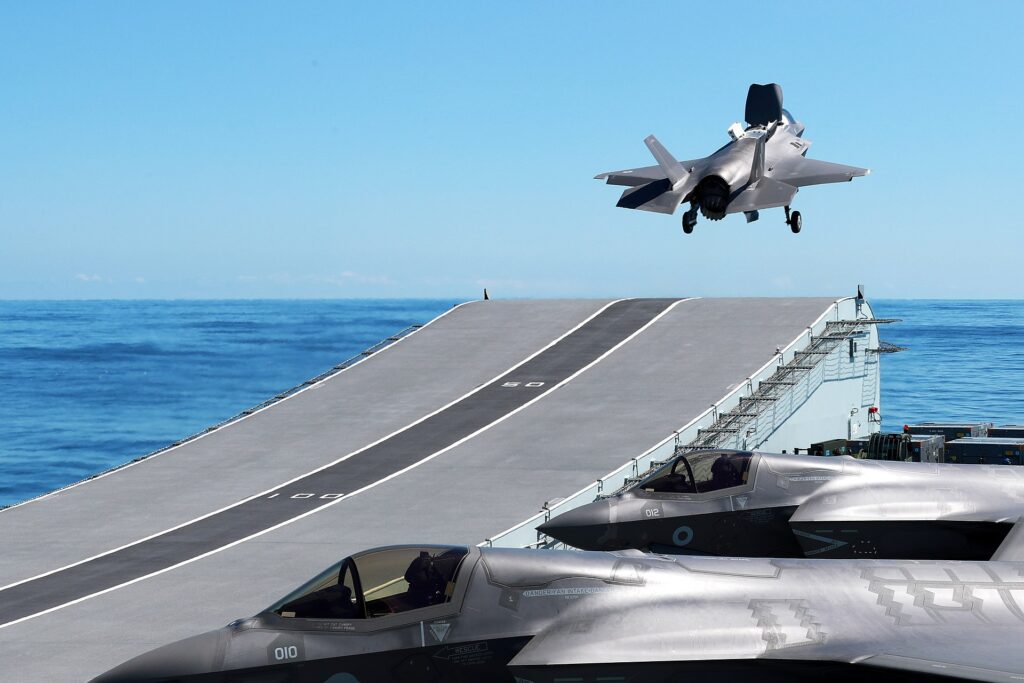
- STOVL and Ski-Jump Rise: The proliferation of the F-35B STOVL fighter has enabled many navies to operate effective carriers without catapults. The UK, Italy, Japan, South Korea, and others are adopting F-35B aircraft on relatively small carriers or amphibious ships. For example, Japan plans to operate F-35B from its Izumo-class ships, and Italy will deploy ~20 F-35Bs on Trieste. This STOVL trend emphasizes “big-deck amphibious” carriers: ships originally designed for helicopters are modified to carry jets. Compared to CATOBAR carriers, STOVL carriers are simpler (no catapults/arrestors) but carry fewer aircraft.
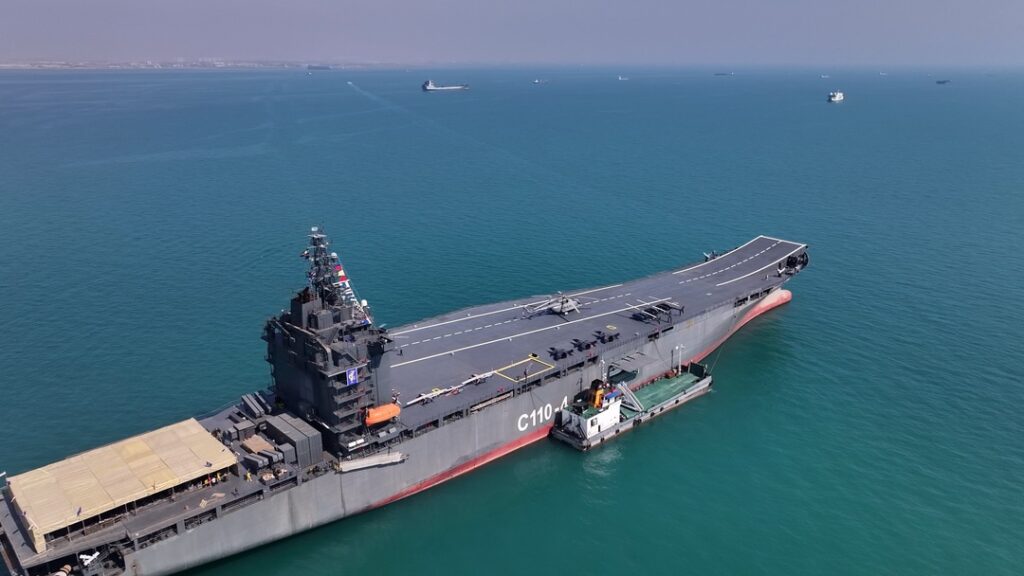
- Unmanned Aircraft (Drones): Navies are integrating UAVs/UCAVs into carrier operations. Turkiye’s TCG Anadolu has been repurposed as a drone carrier, successfully launching the Bayraktar TB3 UAVs. Iran’s IRGCN converted merchant ships into drone carriers (e.g. Shahid Bagheri) to deploy swarms of kamikaze drones. China has unveiled a large drone carrier prototype (~200m, multiple islands) for VTOL UAS trials. Thus, a trend is emerging of carriers (especially smaller or amphibious ones) optimized for unmanned aviation: persistent ISR and strike without risking pilots.
- Nuclear vs. Conventional Power: There is a division between nuclear-powered supercarriers and conventionally powered carriers. The US and France continue to invest in nuclear propulsion for carriers (unlimited range, high power). France’s planned future carrier (PANG) will be nuclear, preserving uninterrupted carrier aviation knowledge. By contrast, China, India, the UK, and others have so far built large carriers with gas turbines or diesels, favoring lower cost and simpler maintenance. However, some emerging powers (India, possibly the UK again, or others) continue to study nuclear options. As [37] notes: “It remains [China’s carrier] has no nuclear … whereas all the US and French carriers are nuclear-powered”. The trend seems that only the wealthiest navies currently choose nuclear, but the balance could shift if more industries support marine reactors.
- Amphibious Assault as Air Power Platforms: An emerging trend is that large amphibious assault ships (LHD/LHAs) are being built with carrier-like aviation capabilities. A UK example: after retiring HMS Ocean, the UK relies on its QE-class carriers. Japan expanded the role of its LPDs. More notably, navies are designing new LHDs with ski-jumps and F-35 support (e.g. Australian Canberra class, Italian Trieste). Navy Lookout notes the U.S. and NATO allies are exploring “hybrid” carriers by adding drones or STOVL jets to LHDs. For instance, Italy’s Trieste (230m deck) and Spain’s Juan Carlos I (231m) are explicitly F-35B-capable. This reflects a desire for versatile platforms that combine amphibious lift with air power, often driven by constraints on building full supercarriers.
- Shipborne Systems and Autonomy: Carriers increasingly incorporate advanced networks and automation. New design features include electromagnetic launch and recovery (EMALS, Advanced Arresting Gear), optical landing aids, and stealth coatings to reduce radar signature of the flight deck. Some carriers (e.g. Ford, future Fujian) have sophisticated integration with network-centric warfare systems and unmanned systems. Additionally, there is interest in unmanned shipborne fighters (e.g. the US X-47B and Navy MQ-25 tanker drone experiments) which may carry out routine sorties from carriers. The broad trend is that carriers will operate mixed manned–unmanned air wings in the future.
In summary, while the classic large CATOBAR supercarrier remains a key asset for major powers, there is diversification in carrier types worldwide: smaller STOVL carriers, hybrid drone carriers, and advanced nuclear carriers. The global carrier fleet is expanding (e.g. new Chinese and Indian carriers, more amphibious carriers in East Asia and Europe), reflecting the continuing emphasis on sea-based air power despite evolving threats like long-range missiles. Carriers remain “100,000 tons of diplomacy” – potent symbols and instruments of maritime strategy.